Best Caulk Guns for Weekend Repairs: Control, Drip Management, and Cleanup
This guide includes Amazon affiliate links. If you buy through them, this site may earn a commission. Product selection is based on documented features, not hands-on testing. Read the disclosure.
In this guide
- Choose by the job you actually have
- Newborn 930-GTD: a sensible starting point for small repairs
- Dripless ETS2000: consider it when you want a composite frame
- Newborn 250: choose more thrust when the material needs it
- Understand what the ratio changes
- Prepare the work area before opening the tube
- Give yourself a short practice run
- Make the final choice a compatibility check
- Store the gun ready for the next repair
- Sources & approach
The best caulk gun for your weekend repair is the one that matches your cartridge and lets you control the bead without fighting the trigger. A higher thrust ratio is useful for thicker materials, but it does not automatically make a gun better for delicate trim work.
These three manual guns give you distinct starting points: the Newborn 930-GTD for ordinary lighter-flow materials, the Dripless ETS2000 for a composite-body option, and the Newborn 250 when the sealant calls for more thrust. The recommendations below compare documented features and fit; they do not claim hands-on testing.
Check the sealant instructions first, including cartridge format, application temperature, and any dispenser recommendation. A good gun cannot make the wrong sealant suitable for a joint, or make an expired cartridge flow normally.
Choose by the job you actually have
| Gun | Documented ratio | Where to start | Main trade-off |
|---|---|---|---|
| Newborn 930-GTD | 10:1 | Standard lighter-flow caulks | Do not assume enough thrust for thick adhesives |
| Dripless ETS2000 | 12:1 on the Amazon listing | Composite-body option for routine sealing | Grip comfort still depends on your hand |
| Newborn 250 | 18:1 | More viscous compatible sealants | You control pressure release manually |
The comparison covers the individual guns for standard cartridges, not a bundle with sealant or finishing accessories. The linked listings can offer other packages, so check the selected model and quantity again before you order.
Newborn 930-GTD: a sensible starting point for small repairs

You should put the 930-GTD on your shortlist if you mainly tackle small kitchen, bath, or trim sealing jobs with compatible lighter-flow material. Newborn specifies a 10:1 ratio, a drip-free mechanism, and capacity for 10-ounce, one-tenth-gallon cartridges.
The manufacturer describes a rod that relieves pressure when you let go of the trigger. That behavior is useful when your work involves short runs and frequent stops, such as moving between separate sections of trim.
You also get a comfort-grip trigger, a spout cutter, and a seal-puncture tool. Those are practical conveniences if you want fewer loose items to gather before opening a cartridge.
The limitation is the material, not just the size of your project. If your adhesive is difficult to dispense or its manufacturer calls for higher thrust, do not keep squeezing harder and assume this model must be right for everything.
Dripless ETS2000: consider it when you want a composite frame

You may prefer the ETS2000 if you want a composite-body gun and a rotating barrel for repositioning the cartridge. The manufacturer’s product page also documents an ergonomic grip, a built-in cutter, and a long clean-out tool.
The Amazon listing identifies the individual ETS2000 for 10-ounce cartridges and specifies a 12:1 ratio with a retracting mechanism. That gives you a different combination of frame material and dispensing design from the two Newborn options here.
Think about how you hold the gun when you reach a corner. A rotating barrel lets you change the nozzle orientation without asking your wrist to make every adjustment.
That feature does not guarantee that the trigger will fit your hand comfortably. If hand strain is your main concern, check the return terms and try the unloaded grip before you commit to a long sealing session.
Newborn 250: choose more thrust when the material needs it
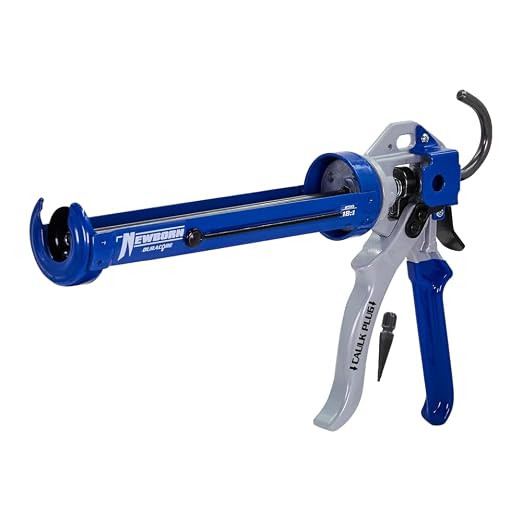
You should look at the Newborn 250 when a compatible thicker sealant or adhesive makes a lower-thrust tool an awkward match. Newborn specifies an 18:1 ratio, a smooth rod, and a revolving cradle for 10-ounce cartridges.
The manufacturer lists a cutter, a puncture tool, and a thumb-operated pressure-release plate. Its product page identifies applications across several material types, including hybrids and polyurethanes, but you still need to follow the cartridge’s own dispensing instructions.
This model’s important distinction is that you manage the pressure release. Practice reaching the release before you start a visible joint, so stopping the bead becomes part of the movement.
You do not need the 250 simply because it looks more substantial. If your work is a few short beads of ordinary painter’s caulk, the extra thrust may be less useful than a stop-and-start mechanism you find easier to manage.
Understand what the ratio changes
A thrust ratio describes mechanical advantage at the trigger, not the quality of the finished joint. You still control travel speed, nozzle opening, and the amount of material you put where it belongs.
Newborn explains that increasing mechanical advantage trades material travel for force. You may need more trigger strokes to move the same volume, so matching the material matters more than choosing the largest number.

Before treating resistance as a gun problem, check whether the cartridge is open correctly and whether the material is within its application conditions. Stop if something feels jammed rather than using the trigger as a way to force through an unknown blockage.
Prepare the work area before opening the tube
Set down a protective surface, a place for the gun between beads, and the cleanup supplies specified for your sealant. You will have a much calmer first attempt if you do not need to cross the room while the nozzle is open.

Read the cartridge directions for surface preparation and tooling rather than assuming every caulk works like the last one you used. Keep the gun and the finishing task separate in your mind: dispensing material is only one part of making a durable joint.
If you are scraping or sanding painted trim in an older home, deal with possible lead hazards before starting. EPA’s homeowner guidance explains why disturbing pre-1978 painted surfaces needs appropriate planning and precautions.
Give yourself a short practice run
Use scrap material to practice starting, moving, and stopping before you touch a prominent seam. You are learning the relationship between your trigger pressure and your hand movement, not trying to win a speed contest.
Try a short bead, stop deliberately, and notice what happens at the nozzle. With a manual-release gun, make releasing pressure part of that stop; with a pressure-relieving design, still check the nozzle rather than assuming it can never ooze.
Keep the opening modest at first and adjust according to the joint and the sealant instructions. An opening you have made too large cannot be made smaller by wishing the gun were more precise.
Make the final choice a compatibility check
Before you buy, confirm cartridge capacity, the exact model, and whether the listing is for one gun or a kit. You can then choose between ordinary drip-free control, a composite frame, or extra mechanical advantage with fewer surprises.
Skip star ratings as a substitute for that check. Your useful purchase is the tool that fits the material, the working space, and the way you need to start and stop on this particular repair.
Store the gun ready for the next repair
After the job, follow the sealant instructions for closing or storing the cartridge and clean the gun before residue hardens around moving parts. Keep cutters and puncture tools away from children, and put the unloaded gun somewhere you can reach without digging through sharp tools.
Make a quick note of the material you used, where you used it, and anything you would change next time. That small record is more useful than remembering that you bought “the good gun” but forgetting which sealant and preparation produced the joint.
If another project needs a different cartridge format, start the compatibility check again. A tool that worked around your sink is not automatically the dispenser you need for every adhesive, bulk pack, or larger tube in the store.
Sources & approach
Checked October 20, 2026. Practical examples and concept drawings are editorial aids; they are not completed Archie remodeling projects.
- newborncaulkguns.com/products/930-gtd
- newborncaulkguns.com/products/250
- dripless.com/tools/caulking-guns/ets-series/ets2000
- newborncaulkguns.com/blogs/news/thrust-ratio-for-caulk-guns-explained
- www.epa.gov/lead/reduce-risk-lead-exposure-home
- www.amazon.com/dp/B000BQS5GO
- www.amazon.com/dp/B0002CKG1O
- www.amazon.com/dp/B0002YTSYS